Few foods are as recognizable as pizza. Before anyone takes the first bite, there is often another familiar moment: the pizza arrives, the box opens, and a round pie has been divided into triangular slices.
It seems like the obvious way to cut a pizza.
But why triangles?
The answer has less to do with tradition alone and more to do with the shape of the pizza itself.
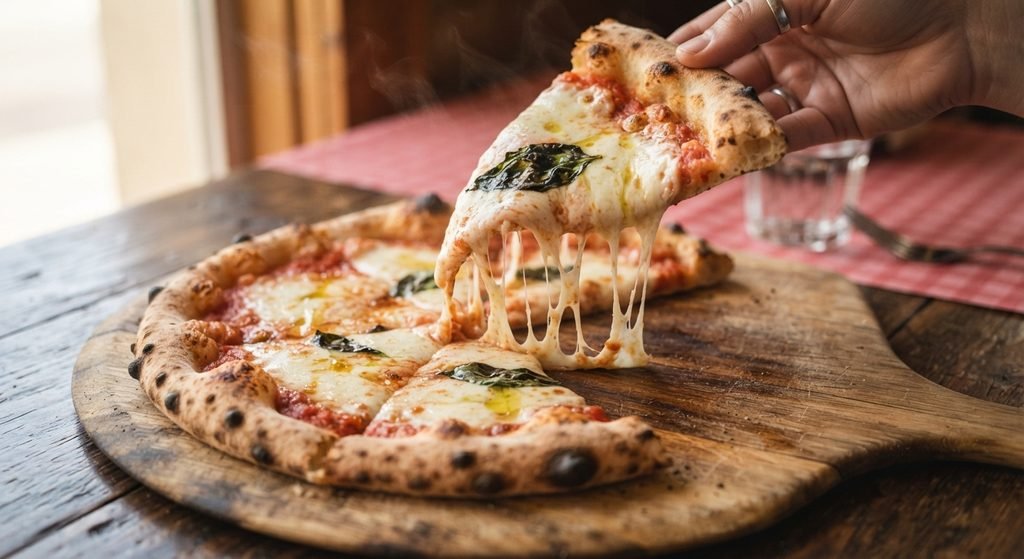
It Starts With a Circle
Most traditional pizzas are round.
A circle is convenient for several reasons. Dough can be stretched naturally into a round shape, it cooks evenly in an oven, and the finished pizza can be rotated easily while baking.
Once you have a round pizza, dividing it into equal portions becomes a simple geometric problem.
Cutting from the center toward the edge creates triangular sections that are relatively easy to distribute among several people.
Why Not Squares?
Square or rectangular cuts are common in some pizza traditions, particularly with styles baked in rectangular pans.
These pizzas are already shaped like a rectangle, so cutting them into smaller squares or rectangles makes practical sense.
The difference is a reminder that pizza culture is not built around one universal method.
The shape of the pizza often determines the shape of the slice.
The Triangle Is Practical
A triangular slice has another useful feature: it gives the person eating it a narrow point and a wider crust end.
This makes it easy to pick up from the crust and eat toward the center.
The crust acts almost like a natural handle.
That may seem like a small detail, but it makes the triangular slice remarkably practical for casual eating.
The Center Creates the Pattern
When a round pizza is divided evenly, the cuts usually meet near the center.
Each cut creates two edges, and repeated cuts produce a series of wedge-shaped pieces.
The more slices you make, the narrower each wedge becomes.
This makes it easy to adjust portion sizes without changing the basic cutting method.
Pizza Traditions Differ Around the World
Not every pizza is served in triangular slices.
In Naples, traditional round pizzas are commonly served whole and may be eaten with a knife and fork, particularly in a restaurant setting.
In other places, pizza is more commonly cut into slices designed to be eaten by hand.
New York-style pizza, for example, became strongly associated with large triangular slices that can be folded while eating.
The same basic food therefore developed different eating customs depending on place and culture.
The Slice Became Part of Pizza Culture
In many parts of the world, the triangular slice became almost as recognizable as the pizza itself.
It appears in restaurants, takeout boxes, advertisements, illustrations, and popular culture.
The shape immediately communicates what the food is, even before the toppings can be identified.
That is a good example of how a practical decision can eventually become part of a food’s visual identity.
A Simple Shape With a Long History
There is no single moment when someone decided that all pizzas should be cut into triangles.
Instead, the shape developed naturally from the combination of a round pizza, shared portions, and convenient eating.
As pizza spread internationally, local traditions added their own methods of shaping, baking, cutting, and serving it.
Final Thoughts
Pizza is often associated with its toppings, crust, and sauce, but even the way it is cut tells part of its story. Triangular slices work because they fit the geometry of a round pizza, divide it into portions efficiently, and provide a convenient way to hold the slice by its crust.
Sometimes the most familiar food traditions are simply practical ideas that became cultural habits.