A blender can be useful for far more than making smoothies. It can help prepare soups, sauces, dressings, frozen drinks, and many other recipes.
With countertop models, personal blenders, and high-powered options available, choosing the right one depends largely on what you plan to make and how often you expect to use it.
Start With How You Cook
Before comparing features, think about what you actually want a blender to do.
If you mainly make smoothies or small portions, a compact blender may be enough. If you regularly prepare soups, sauces, or larger batches, a full-size countertop model may be more practical.
The best blender is not necessarily the most powerful one. It is the model that matches your typical cooking routine.
Consider the Capacity
Blender jars come in different sizes, and capacity can affect how convenient the appliance is.
A smaller container works well for individual portions and takes up less storage space. A larger jar is more useful when preparing drinks, soups, or sauces for several people at once.
Think about the quantities you normally prepare rather than choosing the largest container available.
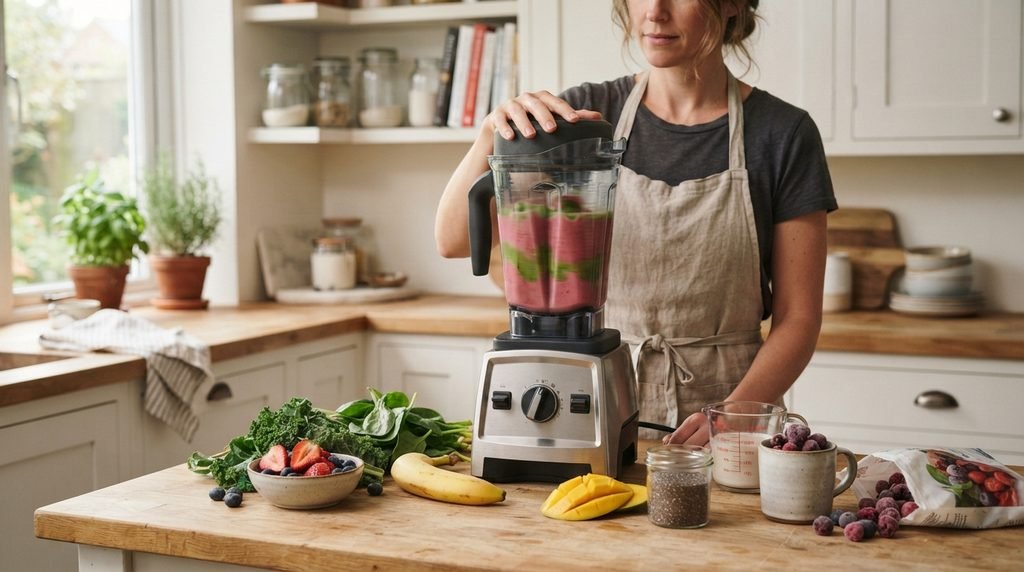
Pay Attention to Power
Motor power can affect how well a blender handles demanding ingredients, but wattage alone does not tell the whole story.
A blender designed for everyday smoothies may not need the same performance as one intended to crush ice, blend frozen fruit, or process tougher ingredients regularly.
Instead of focusing only on the highest number, consider the manufacturer’s intended use and the types of foods the blender is designed to handle.
Look at the Controls
Simple controls can be an advantage.
Some blenders offer basic speed settings, while others include preset programs for smoothies, soups, frozen drinks, or other preparations.
More settings can provide additional control, but they are not necessarily better if you rarely use them. A straightforward control panel may be more convenient for everyday cooking.
Check the Blade Design
The blades are an important part of how a blender performs.
A well-designed blade system should create enough movement inside the container to bring ingredients toward the blades and produce a consistent mixture.
It is worth considering whether the blade assembly can be removed for cleaning and whether replacement parts are available if needed.
Think About Cleaning
A blender that is difficult to clean can quickly become an appliance you avoid using.
Look for a design that allows easy access to the container and blade area. Some models have dishwasher-safe components, while others are designed to be rinsed and cleaned by hand.
If you use your blender frequently, easy cleanup can be just as valuable as additional performance features.
Consider Counter and Storage Space
Blenders can take up more room than expected, particularly larger high-powered models.
Before buying one, consider where you will keep it and whether it will fit comfortably beneath your kitchen cabinets if you plan to leave it on the counter.
An appliance that fits naturally into your kitchen is more likely to become part of your regular cooking routine.
Think About Noise
Powerful blenders can be noticeably loud during operation.
If noise is important to you, especially in a small kitchen or shared living space, consider this before making a purchase. A quieter model may be worth considering if you expect to use the blender frequently.
Consider Durability
A blender is an appliance that can receive considerable use, particularly in a busy kitchen.
Pay attention to the quality of the container, controls, base, and overall construction. It is also useful to check whether replacement containers, blades, or other parts are available.
A durable blender that can be maintained over time may be more useful than a cheaper model that needs to be replaced frequently.
Final Thoughts
Choosing a blender starts with understanding your own cooking habits. Consider the foods you prepare, the quantities you normally make, the available kitchen space, and how much cleaning you are willing to do.
For occasional smoothies, a simple compact model may be all you need. For frequent cooking and larger batches, a full-size blender with stronger performance may make more sense.
The right blender is the one that provides the features you will actually use without adding unnecessary complexity to your kitchen.