Few desserts are as recognizable as the fortune cookie. Its folded shape, crisp texture, and tiny paper message have become closely associated with Chinese restaurants in the United States and beyond.
There is just one surprising detail: the fortune cookie did not originate in China.
The Story Begins in Japan
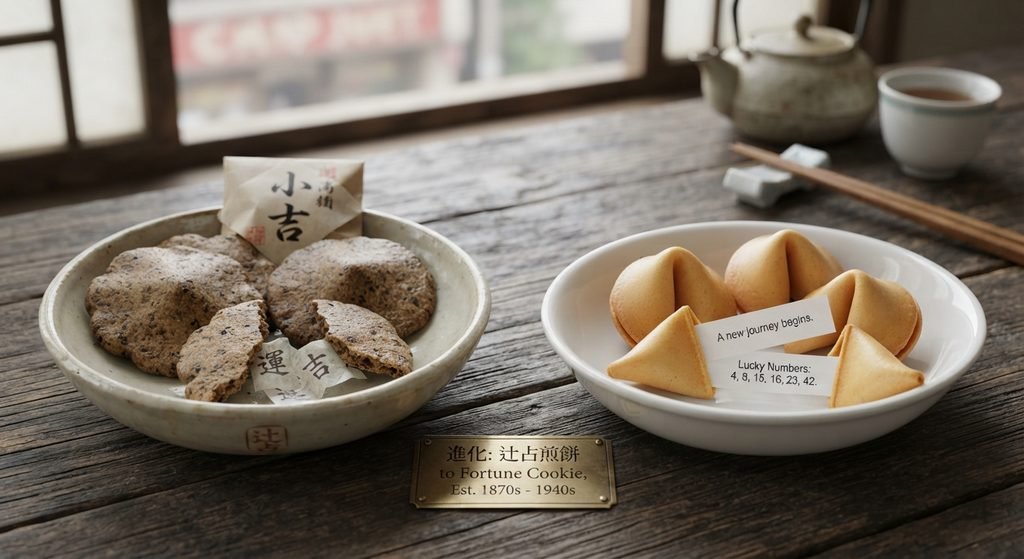
The roots of the modern fortune cookie can be traced to Japanese crackers known as tsujiura senbei.
These crackers were made in Japan by at least the late 19th century and were larger and darker than the fortune cookies commonly served in American restaurants today. They were traditionally flavored with ingredients such as sesame and miso, and the written message was placed in the fold of the cracker.
The connection is important because it shows that the familiar fortune cookie developed from a much older Japanese confectionery tradition.
How Did It Reach the United States?
Japanese immigrants brought their food traditions to the United States around the turn of the 20th century.
Japanese bakeries in California began producing versions of these crackers, and one of the best-documented connections is San Francisco’s Japanese Tea Garden.
The Japanese confectionery Benkyodo supplied fortune cookies to the Japanese Tea Garden, where they were served to visitors. The Smithsonian has preserved the tools associated with this early production.
At this point, the cookie still had little to do with Chinese restaurants.
The Cookie Changed in America
The American version gradually became lighter, sweeter, and more delicate than its Japanese predecessors.
The flavor also changed. Modern American fortune cookies commonly use ingredients such as flour, sugar, vanilla, and oil, giving them the familiar crisp, sweet character.
The exact inventor remains disputed. Several Japanese and Chinese American businesses have been associated with the early development of the American fortune cookie, so there is no universally accepted single inventor.
So Why Chinese Restaurants?
The answer is closely connected to American restaurant culture.
Fortune cookies became increasingly common in Chinese restaurants in the United States during the first half of the 20th century.
Japanese American bakeries supplied some Chinese restaurants with the cookies, creating an association that eventually became so strong that many people assumed the cookie itself was Chinese.
By the 1930s, fortune cookies were being served as complimentary desserts in Chinese restaurants across America.
World War II Changed the Industry
The history took another major turn during World War II.
After the attack on Pearl Harbor, Japanese Americans on the West Coast were forcibly removed and incarcerated under U.S. government policy. Japanese American businesses, including bakeries producing fortune cookies, were disrupted or closed.
Chinese American manufacturers began producing more fortune cookies to meet the demand from restaurants.
This helped move production and the restaurant association of the cookie further toward Chinese American businesses.
The Message Inside
The paper message is what makes the fortune cookie different from an ordinary wafer.
The fortunes have changed over time. Some contain short sayings or pieces of advice, while others include lucky numbers, jokes, or playful predictions.
The Library of Congress explains that the cookies are baked as flat circles and folded around the paper while they are still warm. As they cool, they harden into their familiar folded shape.
That simple process is one of the reasons the cookie can be manufactured efficiently on a large scale.
A Japanese-American Food Story
The fortune cookie is therefore a fascinating example of how food traditions can change when they cross borders.
A Japanese-inspired confection became established in the United States, developed into a distinctly American product, and eventually became strongly associated with Chinese American restaurants.
Its history is not a simple story of one inventor or one country. It is a story shaped by immigration, entrepreneurship, restaurants, war, and changing American food culture.
Final Thoughts
The fortune cookie is associated with Chinese restaurants today, but its history points primarily toward Japan and the United States. Its journey shows how a food can cross cultures, change along the way, and eventually become something that feels completely different from its original form.