Resting meat after cooking is one of those kitchen instructions that many people follow without thinking twice.
You take a steak, roast, or chicken out of the oven or pan, place it on a plate, and wait before cutting it. But does those few extra minutes actually make the meat juicier, or is resting simply another cooking tradition?
There is a real reason behind the practice, although it is slightly different from the way it is often explained.
What Happens While Meat Cooks?
As meat is exposed to heat, its proteins change and its internal temperature rises.
At the same time, moisture inside the meat moves and some of it can be pushed toward the center or released as the meat cooks.
When you cut into very hot meat immediately after cooking, some of the juices can run onto the cutting board or plate.
That means less of that moisture remains in the meat when you eat it.
What Happens During Resting?
When meat is removed from the heat, the cooking process does not necessarily stop immediately.
The internal temperature can continue to rise for a short period, particularly with larger pieces of meat.
As the meat begins to cool slightly, its internal juices can become more evenly distributed.
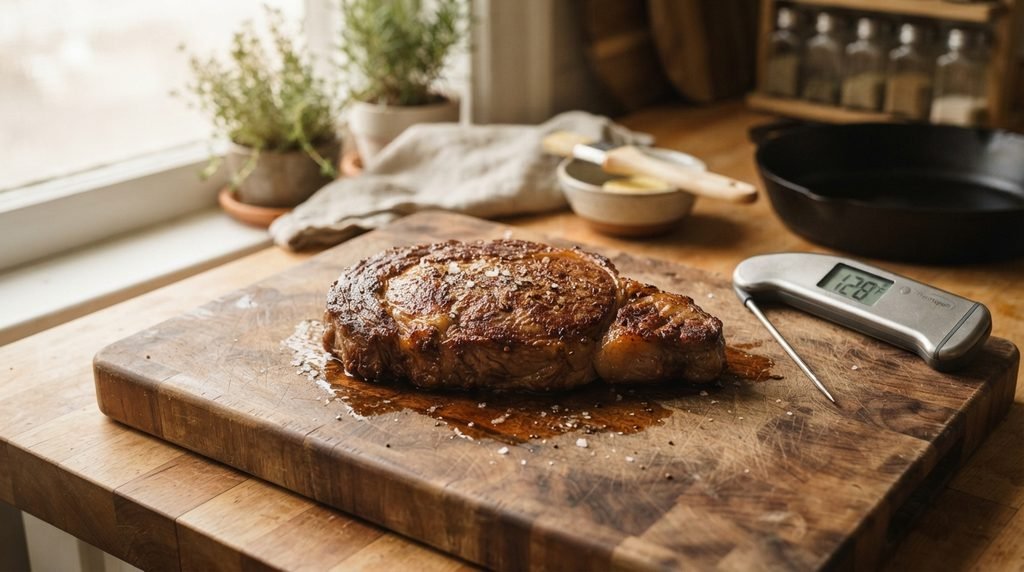
Resting therefore gives the meat time to settle before it is sliced.
Does Resting Actually Put the Juice Back Inside?
Not exactly.
One common explanation is that resting somehow forces all the juices back into the center of the meat.
That is an oversimplification.
Resting does not magically return moisture that has already been lost. Instead, it gives the meat time to redistribute moisture and allows the internal structure to relax somewhat before cutting.
The result can be a smaller amount of juice escaping immediately onto the plate.
Does Every Cut Need the Same Resting Time?
No.
The ideal resting time depends largely on the size and type of meat.
A thin steak usually needs only a short rest, while a large roast benefits from a longer period before carving.
A small piece of meat loses heat relatively quickly, so leaving it untouched for too long may cause it to become cooler than desired.
Larger cuts retain heat for much longer and generally benefit more from resting.
What About Chicken?
Resting can also be useful for chicken.
After cooking, allowing chicken to rest briefly gives the juices time to settle before slicing.
However, food safety remains the priority. Poultry should be cooked to a safe internal temperature, measured with a reliable food thermometer.
Resting should never be used as a substitute for properly cooking meat.
What Happens If You Cut Meat Immediately?
The difference can be easy to see.
Cut a freshly cooked piece of meat immediately and you may notice a significant amount of liquid collecting on the cutting surface.
If you allow another piece of the same meat to rest before cutting, less liquid may escape immediately.
This does not necessarily mean that the rested piece contains dramatically more moisture overall. It means that more of its natural juices remain within the meat rather than being released all at once when you make the first cut.
Can You Rest Meat for Too Long?
Yes.
Resting is not an endless process.
If meat sits for too long, its temperature can drop significantly. For foods that are best served hot, excessive resting can reduce the eating experience even if the meat remains moist.
The goal is to find a practical balance between allowing the meat to settle and serving it at an enjoyable temperature.
Should You Cover It?
This depends on the situation.
Loosely covering a larger roast can help reduce heat loss while it rests. However, tightly covering meat can trap steam against the surface.
For foods where a crisp exterior is important, such as roasted chicken, keeping the surface exposed or only loosely covered can help preserve some of that texture.
The Simple Test
The easiest way to understand the difference is to compare two similar pieces of meat.
Cook them under the same conditions. Remove one and slice it immediately. Let the other rest for several minutes before cutting.
Compare the amount of liquid released onto the cutting board and observe the texture of each piece.
The rested meat will generally lose less liquid immediately when sliced, which helps explain why resting has become such a common cooking practice.
Final Thoughts
Resting meat is not a magical technique that adds moisture to a finished piece of meat.
Its real benefit is giving the meat time to settle after cooking, allowing moisture to redistribute and reducing the amount of juice that escapes immediately when it is sliced.
For small cuts, a few minutes may be enough. Larger roasts generally need more time.
It is a simple step, but when you have put effort into cooking a good piece of meat, giving it a little time before cutting can be well worth it.