Does boiling potatoes before roasting really make them crispier? Many cooks swear by this extra step, but the reason it works has more to do with starch and surface texture than simply cooking the potatoes twice.
The Test
Cut potatoes into similar-sized pieces and divide them into two batches.
Roast one batch directly after seasoning and coating it with oil.
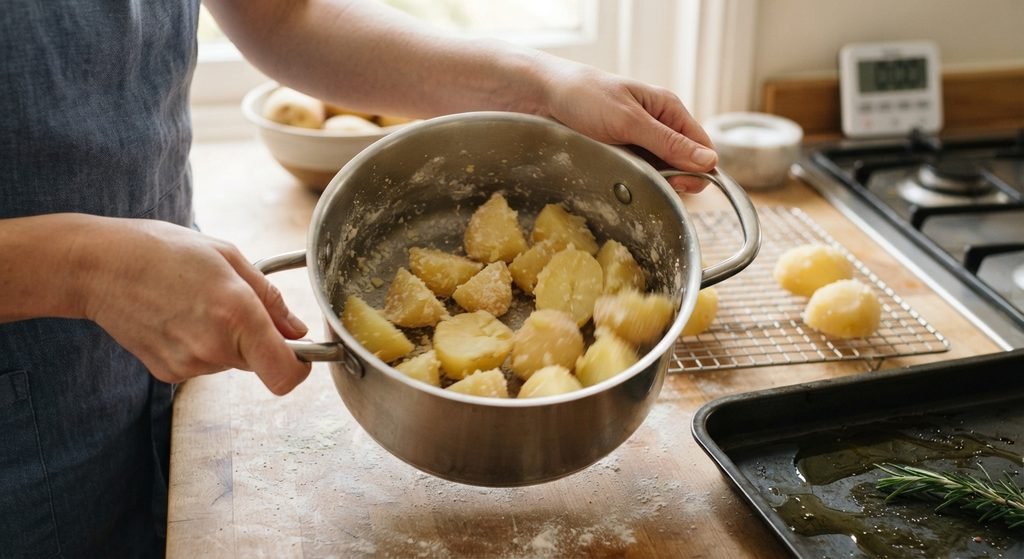
Boil the second batch in water until the exterior begins to soften but the centers remain firm. Drain them thoroughly, then gently shake or toss them to roughen the surfaces before adding oil and roasting.
Use the same oven temperature and roasting time for both batches.
What Happens to Raw Potatoes?
Raw potatoes can certainly become crisp in the oven, but their surfaces do not start with the same structure as potatoes that have been partially boiled.
The exterior contains starch and moisture, and the surface needs to lose enough water before strong browning and crisping can develop.
The result can be a crisp exterior, but the texture depends heavily on the potato variety, size, oven temperature, and amount of oil.
What Does Boiling Change?
Boiling partially cooks the potato and allows its starch to absorb water and swell.
This process changes the structure of the outer layer.
Once the potatoes are drained and roasted, that cooked starch can contribute to a rougher surface that becomes crisp as moisture escapes in the oven.
Why Roughing Up the Potatoes Helps
After boiling, gently shaking the potatoes in a pot or bowl creates small rough edges and a thin layer of starchy material on the surface.
Those rough areas create more opportunities for browning and crisping.
Instead of roasting a perfectly smooth potato surface, you are creating a textured exterior that can become crunchy.
The Crispiness Test
The difference is easiest to notice when both batches are served immediately.
The directly roasted potatoes may develop a firm exterior, but the parboiled potatoes should have more irregular, crisp edges and a softer interior.
The contrast becomes especially noticeable when the potatoes are cut into large chunks.
Does the Potato Type Matter?
Yes.
Different potatoes contain different amounts of starch and moisture, so they do not all behave identically.
Potatoes with a suitable balance of starch and moisture can produce a particularly appealing contrast between a crisp exterior and fluffy center.
The size of the pieces also matters because smaller pieces cook faster and have more surface area relative to their interior.
What About Baking Soda?
A small amount of baking soda can make the boiling water more alkaline, which can encourage the outer layer of the potato to break down more readily.
This can produce an even rougher surface after draining and tossing.
However, it is not essential. The basic combination of partial boiling, draining, roughing up the surface, oil, and high-heat roasting can already produce excellent results.
The Practical Result
If crisp edges are your priority, boiling potatoes before roasting is worth the extra step.
The process partially cooks the interior while changing the surface into something that can develop a more substantial crust during roasting.
Final Thoughts
Boiling potatoes before roasting is more than an extra cooking step. It changes the starch structure and gives the potato a rougher surface that can become exceptionally crisp in the oven. If you want roasted potatoes with crunchy edges and a fluffy center, the experiment strongly favors parboiling first.