Does adding baking soda make onions caramelize faster? It is a kitchen trick that promises to soften onions quickly, but the result is more complicated than simply turning up the heat.
The Test
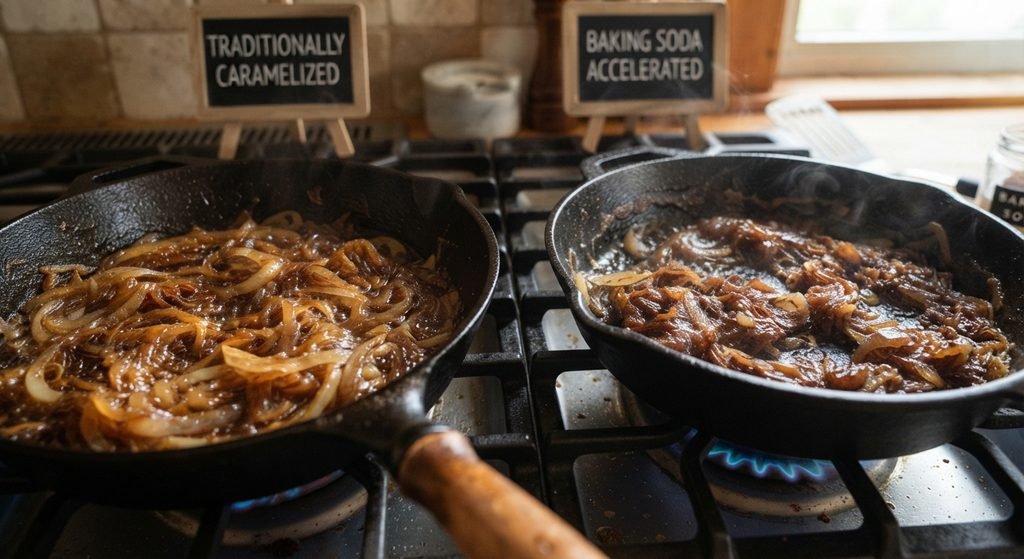
To compare the results, cook two batches of sliced yellow onions in separate skillets.
Use the same amount of onions, oil, heat, and cooking time. Leave one batch completely untreated. Add a very small pinch of baking soda to the other batch after the onions begin to soften.
Compare their color, texture, cooking time, and flavor.
What Happens Without Baking Soda?
As onions cook, they gradually lose moisture and become softer. Their natural sugars become more concentrated, while browning reactions develop as the cooking continues.
Given enough time and appropriate heat, the onions become golden, soft, and increasingly sweet.
This process takes time because the onions contain a significant amount of water that must evaporate before deeper browning can develop.
What Does Baking Soda Change?
Baking soda is alkaline, so even a small amount can raise the pH of the onions.
A higher pH can encourage browning reactions and cause the onions to soften more quickly. This is why the baking soda batch may appear to cook faster.
However, faster is not necessarily better.
The Texture Difference
The baking soda batch can become noticeably softer and may break down more quickly than onions cooked without it.
This can be useful when you want onions to become very soft for a sauce, soup, or spread.
For onions where you want distinct slices with a deeper caramelized texture, too much baking soda can work against the result.
What About the Flavor?
This is where the trick becomes less appealing.
Using too much baking soda can give the onions an unpleasant alkaline or slightly soapy taste. It can also change their texture dramatically.
A tiny amount may not be noticeable, but there is little reason to add a large quantity simply to save a few minutes.
Does It Really Make Caramelization Faster?
It can speed up softening and promote browning, but that does not mean it perfectly replicates traditional slow caramelization.
Proper caramelized onions develop flavor through gradual cooking, moisture reduction, sugar concentration, and browning.
Baking soda changes the cooking environment rather than magically creating the same result in less time.
The Practical Result
If the goal is extremely soft onions for a quick dish, a tiny pinch of baking soda can be useful.
If the goal is deeply golden onions with a clean, concentrated flavor and distinct texture, traditional cooking remains the better approach.
The simplest way to test the difference is to cook both batches side by side and taste them at the same stage.
Final Thoughts
Adding baking soda can make onions soften and brown faster, but the shortcut comes with trade-offs. Used carefully, it can be useful for certain dishes, but it is not a replacement for the flavor and texture developed through slower cooking.