Rinsing rice is one of those kitchen habits that many cooks follow without questioning. Some people rinse rice several times before cooking, while others put it straight into the pot.
But does rinsing actually make cooked rice less sticky?
A simple side-by-side experiment can reveal how much difference it makes.
The Test
Use the same type and amount of rice for both samples.
For the first batch, rinse the rice several times under cool water until the water becomes noticeably clearer.
For the second batch, cook the rice without rinsing it.
Use the same cooking vessel, water ratio, heat level, cooking time, and resting time for both batches.
Once cooked, compare the grains carefully.
Why Rice Can Become Sticky
Rice contains starch, and some of that starch is present on the surface of the grains.
When rice is washed, some of the loose surface starch is removed.
During cooking, starch absorbs water and changes texture. The amount and type of starch present on the surface can influence how easily individual grains cling together.
This is one reason rinsing can affect the final texture.
What Happens to Rinsed Rice?
The rinsed batch should generally have grains that separate more easily after cooking, particularly when using varieties where loose surface starch contributes noticeably to stickiness.
The difference may be subtle or significant depending on the type of rice.
Long-grain rice, for example, naturally tends to produce a more separated texture than short-grain varieties.
What Happens to Unrinsed Rice?
The unrinsed sample may appear slightly more cohesive.
That does not necessarily mean it is poorly cooked.
In some dishes, a more cohesive texture is actually desirable.
The important point is that “sticky” and “overcooked” are not the same thing.
The Type of Rice Matters
This is where the experiment becomes more interesting.
Different rice varieties contain different proportions of starch and behave differently during cooking.
Long-grain rice is commonly valued for separate, fluffy grains.
Short-grain rice tends to be naturally more adhesive.
Arborio rice is intentionally used for dishes such as risotto because its starch contributes to the creamy texture of the finished dish.
Rinsing every type of rice in exactly the same way therefore does not produce the same culinary result.
Does More Rinsing Always Mean Better Rice?
Not necessarily.
Repeated washing removes surface starch, but excessive handling can also be unnecessary for recipes where some starch is useful.
The goal should not simply be to make the cooking water perfectly clear.
Instead, consider the texture you want from the finished dish.
A Better Way to Test It
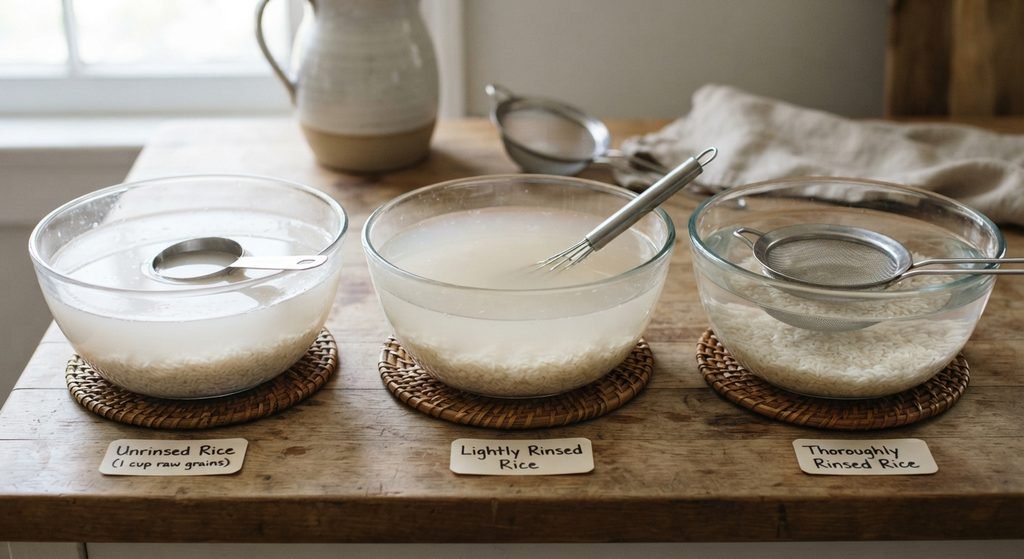
For a more controlled experiment, cook three samples:
- Rice rinsed once
- Rice rinsed several times
- Rice not rinsed
After cooking, place equal amounts on three plates.
Compare how easily the grains separate when stirred with a fork.
You can also allow each sample to cool for several minutes and compare the texture again.
When Rinsing Makes Sense
Rinsing can be useful when you want individual grains that are less likely to cling together.
It is particularly worth considering for rice dishes where a fluffy, separated texture is important.
However, recipes that depend on starch for creaminess may call for a different approach.
The Practical Result
Rinsing rice can reduce some surface starch and influence how the cooked grains behave, but it is not a universal rule for every rice dish.
The variety of rice and the desired final texture matter just as much as the washing step.
Final Thoughts
The experiment shows that rinsing rice is not simply a matter of right or wrong. It is a technique that changes the cooking conditions and can influence texture.
If you want loose, distinct grains, rinsing may help. If a recipe depends on starch and creaminess, keeping more of that starch can be useful.
The best method depends on what you want your rice to become.