Does covering vegetables while cooking help them stay brighter and more colorful? The answer depends on the vegetable, cooking method, and how long it stays in contact with heat and water.
A simple side-by-side experiment can show how much the lid actually changes the result.
The Test
Choose a green vegetable such as green beans or broccoli.
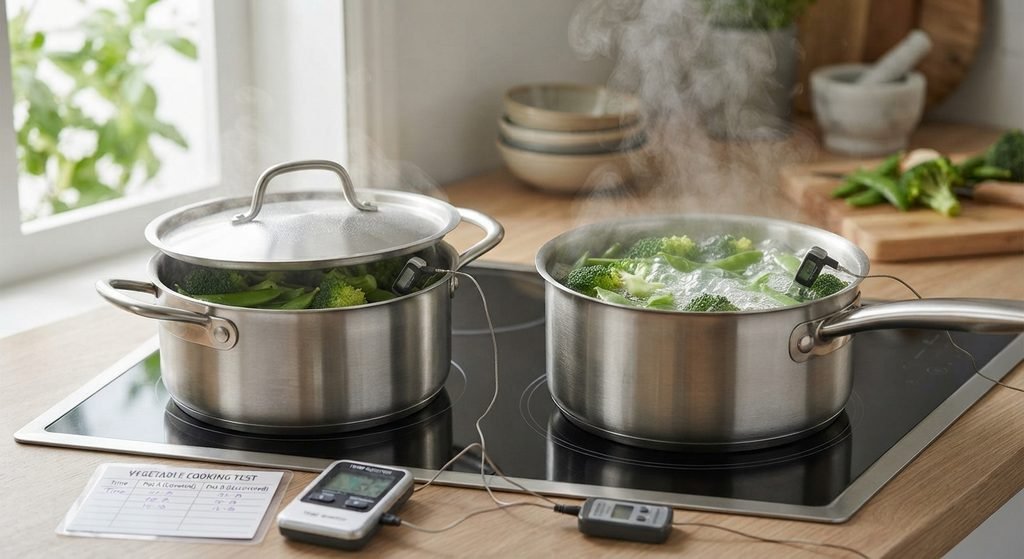
Divide it into two equal portions and cook both portions in the same amount of water.
Cover one pot and leave the other uncovered.
Keep the cooking temperature, vegetable quantity, water amount, and cooking time as similar as possible.
Then compare the color, texture, and amount of water remaining.
What Heat Does to Vegetables
Vegetables naturally contain pigments that give them their characteristic colors.
Heat changes the structure of plant tissues and can also affect those pigments.
The longer vegetables are cooked, the more their texture and appearance can change.
That is why cooking time is one of the most important variables in maintaining a fresh-looking vegetable.
What Does the Lid Change?
Covering a pot traps steam and reduces the amount of heat and moisture escaping from the cooking vessel.
This can change how quickly the water returns to a simmer after vegetables are added.
It can also change the cooking environment inside the pot.
However, simply covering the pot does not guarantee brighter vegetables.
The Importance of Cooking Time
One of the easiest ways to lose vibrant color is to overcook vegetables.
As vegetables remain in hot water for longer periods, their texture becomes softer and their appearance can become less vibrant.
This means that a covered pot may actually produce a less attractive result if it causes the vegetables to cook too quickly and remain in the heat too long.
What Happens With Green Vegetables?
Green vegetables contain chlorophyll, the pigment responsible for much of their green color.
During cooking, several factors can influence how that green appearance changes.
Heat, cooking time, water chemistry, and the condition of the vegetable can all play a role.
The lid is therefore only one part of the experiment.
Texture Is Another Clue
Color is not the only thing worth comparing.
Check whether the vegetables remain firm or become soft.
A good cooking test should evaluate both appearance and texture because a bright vegetable that is overcooked can still be disappointing.
For many vegetables, a shorter cooking time produces a firmer and more appealing result.
The Practical Result
The experiment suggests that controlling cooking time is more important than relying on a lid to preserve color.
A lid can affect how quickly a pot heats and how efficiently it retains steam, but it does not eliminate the effects of prolonged cooking.
If bright, crisp vegetables are the goal, avoid cooking them longer than necessary.
A Simple Kitchen Experiment
Try the experiment again with different vegetables.
Compare green beans, broccoli, peas, and leafy greens.
You can also test three conditions: uncovered, partially covered, and fully covered.
Record the cooking time, color, texture, and amount of water left in each pot.
The results may differ depending on the vegetable.
Final Thoughts
Covering vegetables changes the cooking environment, but it is not a magic solution for preserving color. Cooking time, heat, water, and the vegetable itself all matter. The best way to get vibrant vegetables is to control the entire cooking process rather than relying on the lid alone.