Few things feel as closely connected to going to the movies as a large bucket of popcorn.
The lights go down, the previews begin, and the smell of freshly popped corn fills the theater. Today, popcorn and movies seem almost inseparable.
But it was not always this way.
So how did popcorn become one of the defining foods of the movie theater?
Popcorn Was Around Long Before Movies
Popcorn is much older than the modern cinema.
People in the Americas were eating and preparing corn in different ways long before movie theaters existed. Archaeological evidence shows that varieties of popcorn were cultivated and consumed in ancient cultures.
The important point is that popcorn did not become popular because of movies.
It was already an established snack.
What changed was where people started eating it.
Popcorn Meets the Street
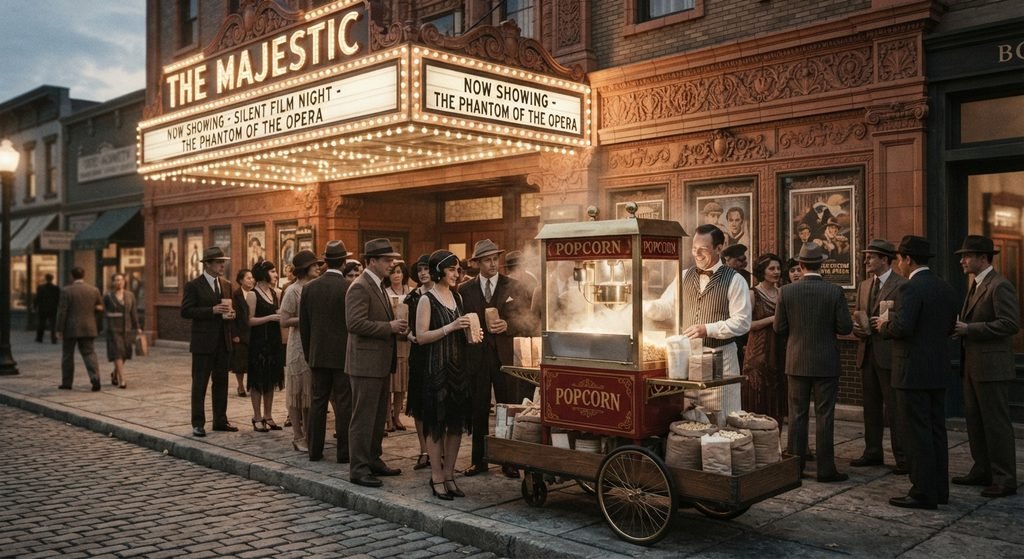
As popcorn became more commercially available, vendors could produce it relatively cheaply using portable equipment.
The smell was also a powerful advantage.
Freshly popped corn is difficult to ignore. Its aroma could attract people from a distance, making it an effective food for busy public spaces.
Popcorn vendors appeared in places where large numbers of people gathered, including fairs, sporting events, and eventually areas around movie theaters.
It was inexpensive, easy to carry, and could be prepared in large quantities.
That combination made it a natural moviegoing snack.
Why Didn’t Movie Theaters Sell It Immediately?
Early movie theaters were often designed to feel more like elegant entertainment spaces than the modern cinemas we know today.
Theaters were concerned about keeping their interiors clean and protecting carpets, seats, and other furnishings.
Popcorn was also associated with street vendors rather than formal entertainment.
For a period, some theater owners did not want food inside their buildings.
But audiences had different ideas.
People were already buying popcorn outside theaters and bringing it with them.
Eventually, the economics became difficult to ignore.
The Rise of the Movie Theater Popcorn
As moviegoing became a major form of entertainment, theater owners began to recognize that popcorn could generate additional revenue.
The snack itself was inexpensive to produce compared with its selling price.
That made popcorn particularly attractive to theaters.
A movie ticket could only be sold once per customer, but food and drinks created another opportunity to earn money during the same visit.
Popcorn became part of the business model.
Over time, the snack became so strongly associated with movies that the combination began to feel natural.
Why Popcorn Works So Well in a Theater
Popcorn has several characteristics that make it particularly suitable for moviegoing.
It is:
- Relatively inexpensive to produce
- Easy to prepare in large quantities
- Simple to serve
- Easy to eat with your hands
- Convenient to carry
- Naturally suited to different flavors and seasonings
- Strongly associated with entertainment and social occasions
It also has something that many snacks lack: aroma.
The smell of freshly popped popcorn can travel through a theater lobby, creating an immediate connection between the food and the experience.
The Smell Became Part of the Experience
Food is closely connected to memory.
The smell of popcorn in a movie theater can become part of the emotional experience of going to the movies.
Over time, this creates a familiar association.
You smell popcorn, and you think about movies.
You walk into a cinema and smell popcorn, and the experience feels incomplete without it.
The snack is no longer simply something to eat. It has become part of the ritual.
Why Is Movie Theater Popcorn So Different?
The popcorn served at cinemas often has a distinctive flavor and aroma.
Part of that comes from the cooking process and the seasonings used.
Movie theaters also have specialized equipment designed to produce popcorn continuously for large numbers of customers.
The result is very different from a small bag of microwave popcorn prepared at home.
Theater popcorn has become its own food experience.
Popcorn Became More Than a Snack
Today, popcorn appears in movie theaters around the world in different forms.
Some cinemas offer traditional salted popcorn, while others sell caramel, cheese-flavored, sweet, spicy, or specialty versions.
The basic idea remains the same.
A simple grain becomes a snack that is easy to share while people sit together and watch a story unfold.
That is part of what makes the tradition so interesting.
Final Thoughts
Popcorn did not become a movie theater tradition because someone decided that movies needed a signature snack.
It happened gradually.
Popcorn was already inexpensive, portable, easy to prepare, and popular with crowds. Movie theaters eventually discovered that selling it made business sense, and audiences embraced the combination.
Today, popcorn and movies are so closely connected that it is difficult to imagine one without the other.
Sometimes food traditions are created not by a single invention, but by the simple combination of convenience, economics, and habit.