A good saucepan is one of the most useful pieces of cookware in any kitchen. It can handle everything from heating milk and making sauces to cooking grains, vegetables, soups, and small portions of pasta.
But saucepans come in different materials, sizes, shapes, and handle designs. Choosing the right one depends largely on what you cook and how you use your kitchen.
Here is what to consider before buying one.
Choose the Right Size
Saucepans are available in several capacities, but a small selection of practical sizes is usually enough for most home cooks.
A 1- to 2-quart saucepan works well for small portions, reheating food, melting butter, and making simple sauces.
A 2- to 3-quart saucepan is a versatile everyday option for oatmeal, rice, soups, sauces, and side dishes.
A 3- to 4-quart saucepan provides more room for larger portions and recipes that need additional space.
A larger saucepan is not necessarily better. A pan that is too large for a small amount of food can make cooking less convenient and may take longer to heat.
Consider the Material
The material affects how the saucepan heats, responds to temperature changes, and needs to be maintained.
Stainless Steel
Stainless steel is durable, versatile, and resistant to staining and corrosion.
It is particularly useful for sauces, boiling, simmering, and general cooking. Many stainless steel saucepans have an aluminum or copper layer inside the base to improve heat distribution.
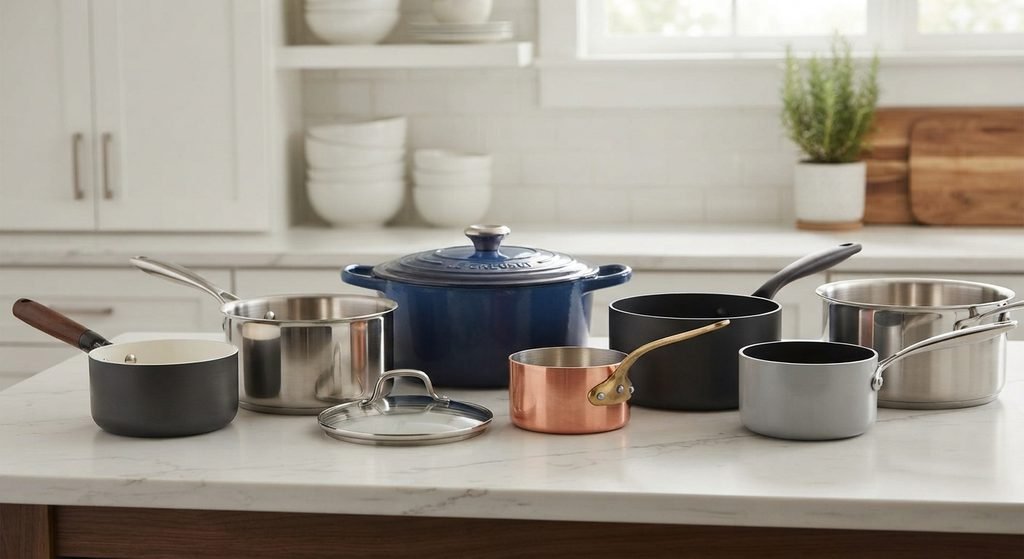
Nonstick
Nonstick saucepans are convenient for foods that tend to stick easily.
They are especially useful for delicate sauces, reheating, and cooking foods with little added fat. However, the cooking surface generally requires more careful handling than bare stainless steel.
Enameled Cast Iron
Enameled cast iron retains heat very well and works nicely for slow simmering.
It is durable but considerably heavier than most stainless steel or aluminum saucepans.
Copper
Copper responds very quickly to changes in heat and offers excellent temperature control.
It is often more expensive and may require additional care depending on how the interior is constructed.
Look at the Base
A good saucepan should heat reasonably evenly across its cooking surface.
A thin base can develop hot spots, which may cause sauces to scorch or food to cook unevenly.
A thicker, well-constructed base generally distributes heat more effectively.
If you are comparing two similar saucepans, pay attention to the base rather than judging the cookware only by its appearance.
Check the Handle
The handle should feel secure and comfortable in your hand.
A long handle makes it easier to lift and move the saucepan while keeping your hand away from the heat.
Some saucepans also have a small helper handle on the opposite side. This can be useful for larger or heavier models.
If possible, hold the pan before buying it. A handle that feels awkward when empty may become even less comfortable when the saucepan is full.
Do You Need a Lid?
A well-fitting lid is extremely useful.
It helps retain heat and moisture when simmering and makes it easier to control evaporation.
A glass lid allows you to see the food without lifting the lid, while a solid lid is generally more resistant to breakage.
The most important factor is that the lid fits securely.
Consider Cleaning
Think about how much maintenance you are willing to do.
Stainless steel can usually handle vigorous cleaning and is a practical choice for everyday use.
Nonstick surfaces are easier to clean but generally require more care to protect the coating.
Enameled cookware is relatively easy to clean but can be heavy to handle.
Your ideal saucepan is not just the one that cooks well. It is the one you will actually enjoy using and maintaining.
Check Compatibility With Your Cooktop
Before buying a saucepan, make sure it is compatible with your stove.
Most cookware works on standard electric and gas cooktops, but induction cooking requires cookware with a magnetic base.
If you use an induction cooktop, always check the manufacturer’s compatibility information before purchasing.
What Makes a Good Everyday Saucepan?
For many home kitchens, a medium-sized saucepan with a sturdy base, comfortable handle, secure lid, and durable cooking surface is enough to cover a wide range of tasks.
You do not need a large collection of saucepans.
One well-chosen saucepan can handle everyday jobs such as:
- Making sauces
- Cooking rice and grains
- Heating soups
- Preparing oatmeal
- Melting butter
- Simmering vegetables
- Reheating leftovers
- Making small batches of soup or stew
Final Thoughts
The best saucepan is not necessarily the most expensive one or the one with the most features.
Focus on size, material, heat distribution, handle comfort, lid fit, cleaning, and cooktop compatibility.
Choose a saucepan that matches the food you regularly prepare, and one reliable piece of cookware can become an everyday essential in your kitchen.