Adding a splash of oil to pasta water is a common kitchen habit. The idea is simple: the oil is supposed to coat the pasta and prevent the noodles from sticking together.
But does it actually work?
We put this familiar cooking trick under the microscope to see whether oil in the water makes a meaningful difference.
The Test
For a simple comparison, cook two batches of the same pasta.
- Batch A: pasta cooked in salted water without oil
- Batch B: pasta cooked in salted water with a small amount of oil
Use the same type and amount of pasta, the same pot size, and the same cooking time.
Once the pasta is drained, compare how easily the noodles separate and how they behave after sitting for a few minutes.
What Happens to the Oil?
The first problem with this trick is that oil and water do not mix well.
The oil mostly stays separate from the cooking water rather than becoming evenly distributed throughout it. Even if some oil comes into contact with the pasta during cooking, it does not create a reliable coating that keeps every noodle apart.
Most of the oil will eventually remain in the cooking water and be discarded when the pasta is drained.
That means the oil has very little opportunity to perform the job it is supposed to do.
So Why Does Pasta Stick?
Pasta becomes sticky mainly because its surface contains starch.
As pasta cooks, starch moves into the surrounding water and can remain on the surface of the noodles. When cooked pasta sits together without enough moisture or movement, those surfaces can stick to each other.
Several factors can make this worse:
- Overcooking the pasta
- Letting cooked pasta sit for too long
- Draining it and leaving it in a pile
- Using too little water for the amount of pasta
- Not stirring during the early stages of cooking
These factors are much more relevant to sticking than whether oil was added to the cooking water.
What Happens in the Test?
When both batches are cooked and drained properly, the difference is surprisingly small.
The oil does not provide a dependable anti-stick effect during cooking.
The more noticeable difference appears afterward.
If the pasta is going directly into a sauce, adding oil to the cooking water offers little practical benefit. The pasta should be drained and combined with the sauce while it is still hot.
If cooked pasta needs to sit before serving, it may begin sticking regardless of whether oil was added to the water.
In that situation, the way the pasta is handled after draining matters much more.
Does Oil Ever Help?
There is one situation where oil can have a different role: pasta that has already been cooked and needs to be stored separately.
A small amount of oil can help coat the cooked noodles after draining, making them easier to separate later. However, this is different from adding oil to the boiling water.
It can also make it harder for a sauce to cling to the pasta if too much oil remains on the noodles.
For pasta that is going straight from the pot into a sauce, this usually isn’t what you want.
What Actually Works?
If you want pasta that does not clump together, focus on the basics.
Stir early.
Give the pasta a good stir shortly after adding it to the boiling water. This helps separate the pieces while their surfaces are still releasing starch.
Use plenty of water.
The pasta needs enough room to move freely and for the starch released into the water to disperse.
Don’t overcook it.
Overcooked pasta tends to become softer and more prone to sticking.
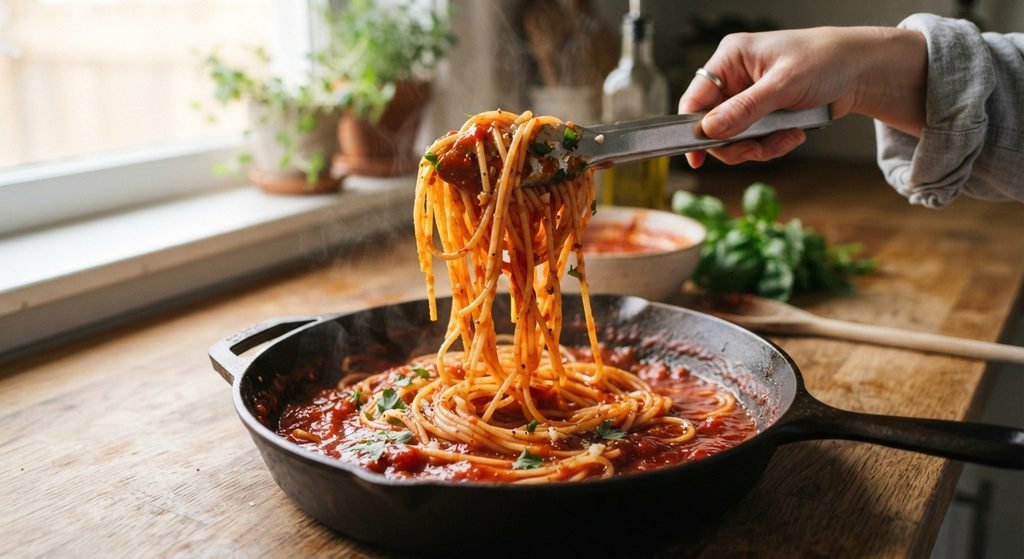
Drain and sauce immediately.
If the pasta is going into a sauce, don’t let it sit in the colander for several minutes. Transfer it directly to the sauce and toss.
The pasta’s starchy cooking water can also help loosen the sauce and bring everything together.
Our Conclusion
Adding oil to pasta water does not reliably prevent pasta from sticking.
The oil and water largely remain separate, so the pasta does not receive the protective coating the trick promises.
Good cooking technique makes a much bigger difference: use enough water, stir the pasta early, cook it properly, and combine it with the sauce soon after draining.
The oil isn’t necessarily harmful, but for most pasta dishes, it’s simply unnecessary.
Final Thoughts
This is one of those kitchen habits that sounds logical until you look at what is actually happening in the pot.
If your pasta is sticking, don’t reach for the oil bottle first. Try improving the cooking process instead.
Sometimes the simplest kitchen experiment is enough to separate a useful technique from a tradition that just keeps getting passed down.